Furusato nozei for foreigners: who can use it, limits and leaving Japan
Furusato nozei for foreigners works the same as for Japanese residents: pay tax in Japan, donate, pay ¥2,000 net. Limits, one-stop rules and leaving Japan.
Foreign residents can use furusato nozei if they pay income tax or residence tax in Japan; nationality and visa type don't matter. You donate to any local government and, within your income-based limit, everything above ¥2,000 a year comes off your taxes. Salaried workers who don't file a tax return and give to 5 or fewer places can use the one-stop exception, with forms due by January 10. If you leave Japan before the next January 1, the residence tax deduction may be lost. As of October 2026.
Yes, furusato nozei for foreigners works exactly as it does for Japanese residents. If you pay income tax or residence tax in Japan, you can donate to any local government and, up to a limit set by your income, everything above ¥2,000 a year comes off your taxes. Visa type and permanent residency (永住) don’t matter. What matters is whether you will still have a Japanese address on the January 1 after you donate. Rules as of October 2026.
Official example
Donate ¥30,000, get ¥28,000 off your taxes
Salaried worker earning ¥7 million a year with a spouse as the only dependant (総務省, Ministry of Internal Affairs and Communications)
How does furusato nozei work?
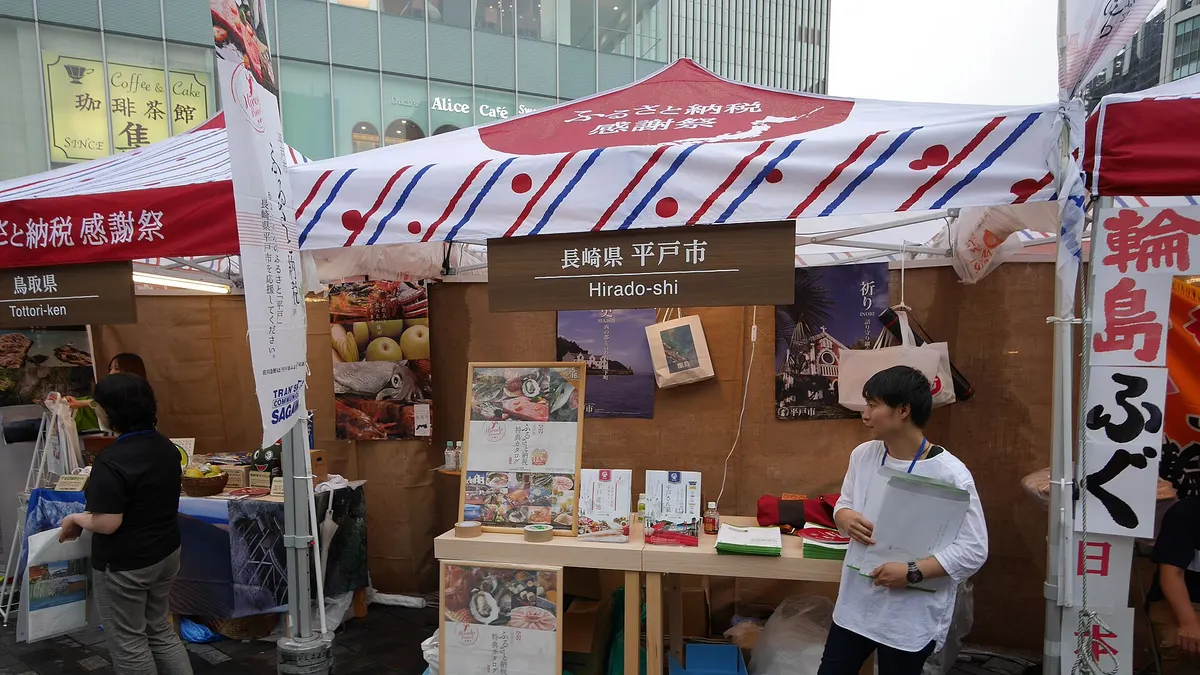
Furusato nozei (ふるさと納税, “hometown tax”) is a donation to a prefecture or city of your choice. It doesn’t have to be your hometown. Some municipalities send a thank-you gift (返礼品) of local products.
The part of your donations above ¥2,000 is deducted from two taxes:
income tax (所得税) for the year you donate
residence tax (住民税) for the next fiscal year, as a lower bill
The ¥2,000 is charged once per calendar year on your total, not per donation. So five donations still cost you ¥2,000 in total, as long as you stay under your limit.
Can foreigners do furusato nozei?
Yes. Nothing in the rules depends on nationality. Two conditions decide whether it pays off for you:
You pay tax in Japan. Residence tax is charged to everyone, including international residents, who has an address in the city on January 1 and income above a threshold. It is based on the previous year’s income (Hiroshima City).
You donate in your own name. Only the taxpayer can claim the deduction. A donation in your spouse’s name counts for your spouse, not for you (総務省 FAQ).
You don’t need permanent residency, a set number of months in Japan or a minimum period left on your residence card (在留カード). You do need a My Number (個人番号) for the one-stop application (see below).
How much can I donate? (furusato nozei limit)
There is no fixed yen limit. The Ministry’s formula has three parts:
Part
Deduction
Cap on donations counted
Income tax
(donation − ¥2,000) × your income tax rate
40% of total income
Residence tax, basic
(donation − ¥2,000) × 10%
30% of total income
Residence tax, special
(donation − ¥2,000) × (100% − 10% − your income tax rate)
Must not exceed 20% of your residence tax income levy (住民税所得割額)
The special part is the one that usually sets your limit. If your donations push it over 20% of your income levy, the special part stops at that cap and your real cost goes above ¥2,000.
Your limit also changes with other deductions, such as dependants. The Ministry says to ask the residence tax section of your city or ward office for an exact calculation, though some offices may not be able to tell you your limit.
One-stop exception or tax return?
You claim the deduction in one of two ways.
One-stop exception (ワンストップ特例)
Tax return (確定申告)
Who can use it
Salaried workers who don’t need to file a tax return
Anyone
Number of municipalities
5 or fewer in the year
No limit
Deadline
Forms must arrive by January 10 of the next year
March 15 of the next year
Where the deduction goes
All of it off next year’s residence tax
Income tax refund for the donation year, plus lower residence tax next year
The one-stop exception stops working if you file a tax return for any reason, for example to claim medical expenses. Then you must list every furusato donation on the return, including ones you sent one-stop forms for (国税庁, National Tax Agency).
If your employer settles your income tax through year-end adjustment (年末調整) and you have no other reason to file a return, one-stop is the simpler route.
Using the one-stop exception
YouDonate to 5 or fewer local governmentsThrough a portal site or the municipality's own site, in your own name
YouAsk for the one-stop formTicking the box on a payment slip is not the application; you must return the form
YouReturn the form with copiesProof of My Number (both sides of your My Number Card, or a 住民票 showing the number) and an ID copy
MunicipalityArrives by January 10One form per municipality; some accept online applications with a My Number Card
Your cityLower residence tax from JuneThe full deduction comes off next year's residence tax
What to send. Nagoya, for example, asks for the application form (申告特例申請書), proof of your My Number and an ID copy. It accepts the residence card as an ID that is enough on its own. Requirements can differ by municipality, so follow the instructions that come with each form.
If you move. If anything on a form you already sent changes, such as your address, send a change notification (変更届出書) to each municipality by January 10 of the next year.
If you file a return. Enter the donations on Form 2 (第二表) under 寄附金控除, and also in the residence tax section (都道府県、市区町村への寄附(特例控除対象)). If you skip the second entry, the residence tax deduction may not be applied. You can fetch donation data through Mynaportal (マイナポータル連携) to fill in the return automatically.
What if I leave Japan mid-year?
This is the part that matters most for foreign residents. With one-stop, the whole deduction comes off residence tax; with a tax return, two of the three parts do. Residence tax is charged to people with an address in Japan on January 1.
When you leave
What this means
After the January 1 following your donation
You still owe that year’s residence tax, so there is a bill to reduce. Leaving on or after January 2 doesn’t end that year’s liability (Hiroshima City).
Before the January 1 following your donation
You may have no residence tax bill the next year, so there is nothing for the residence tax deduction to reduce. Most of the benefit, and the whole one-stop deduction, may be lost.
If you plan to leave Japan before the end of the year, weigh this before donating. Whether you can still claim the income tax part, for example on a tax return filed when you leave, is a question for your tax office or a tax accountant (税理士). This guide can’t advise on your situation.
Leaving Japan also brings its own residence tax steps. Hiroshima City, for example, asks departing international residents to appoint a tax agent living in Japan, and anyone leaving between January 1 and April 30 whose tax comes out of their pay must have the rest taken from their final salary. Your own city may differ. If you are leaving for good, also read our guide to the pension refund (脱退一時金).
Is there a furusato nozei site in English?
Most portals and nearly all one-stop forms are in Japanese. One exception: in September 2023, the food-focused portal MOGUFULL (mogufull.jp) added English and Simplified Chinese menus and content. Its site blocked our checks in October 2026, so we couldn’t confirm English is still offered.
Since October 1, 2025, municipalities may not take donations through sites that give points with donations, according to a TKC summary of the Ministry’s 2024 rule change. Older guides that recommend a portal for its points are out of date.
Are thank-you gifts taxed?
Thank-you gifts count as occasional income (一時所得). Occasional income is taxed only on the part above ¥500,000 a year, added up with other occasional income such as prize money. Most people stay well below that.
Before you donate
Check you will have a Japanese address on the next January 1.
Estimate your limit, and stay below it.
Decide between one-stop (5 or fewer places, no tax return) and a tax return.
Keep every receipt (受領書). For a tax return you can instead attach one annual certificate (寄附金控除に関する証明書) from a business designated by the National Tax Agency.
Yes, if you pay income tax or residence tax in Japan. The rules don't depend on nationality. Residence tax applies to everyone, including international residents, who has an address in a Japanese city on January 1 and enough income.
How much can I donate with furusato nozei?
It depends on your income and other deductions. The residence tax special part is capped at 20% of your residence tax income levy (住民税所得割額); donate more than your limit and you pay more than ¥2,000. The Ministry says to ask your city's residence tax section for an exact figure.
How does the furusato nozei one-stop application work?
If you don't need to file a tax return and give to 5 or fewer local governments, send each one its application form with proof of your My Number and an ID copy. It must arrive by January 10 of the next year. The whole deduction then comes off next year's residence tax.
Can I use my residence card for the one-stop application?
Yes, at least in Nagoya, which lists the residence card (在留カード) as an ID that is enough on its own. You still need separate proof of your My Number. Check the form each municipality sends, because requirements can differ.
What happens to furusato nozei if I leave Japan?
Residence tax is charged to people with an address in Japan on January 1. If you leave before the January 1 after your donation, there may be no residence tax bill to reduce, so most of the benefit can be lost. Ask your tax office or a tax accountant (税理士) before donating in your last year.
Sources
ふるさと納税の概要, 総務省 (Ministry of Internal Affairs and Communications) (accessed Oct 20, 2026)
Gasshuku menkyo in English is rare: camps take about 14 days for AT and include lodging and meals, but lectures are in Japanese. What foreigners need to know.
NISA for foreigners: any resident of Japan aged 18+ can open one, up to ¥3.6M a year. Leave for your own reasons and the account closes. What to know first.